
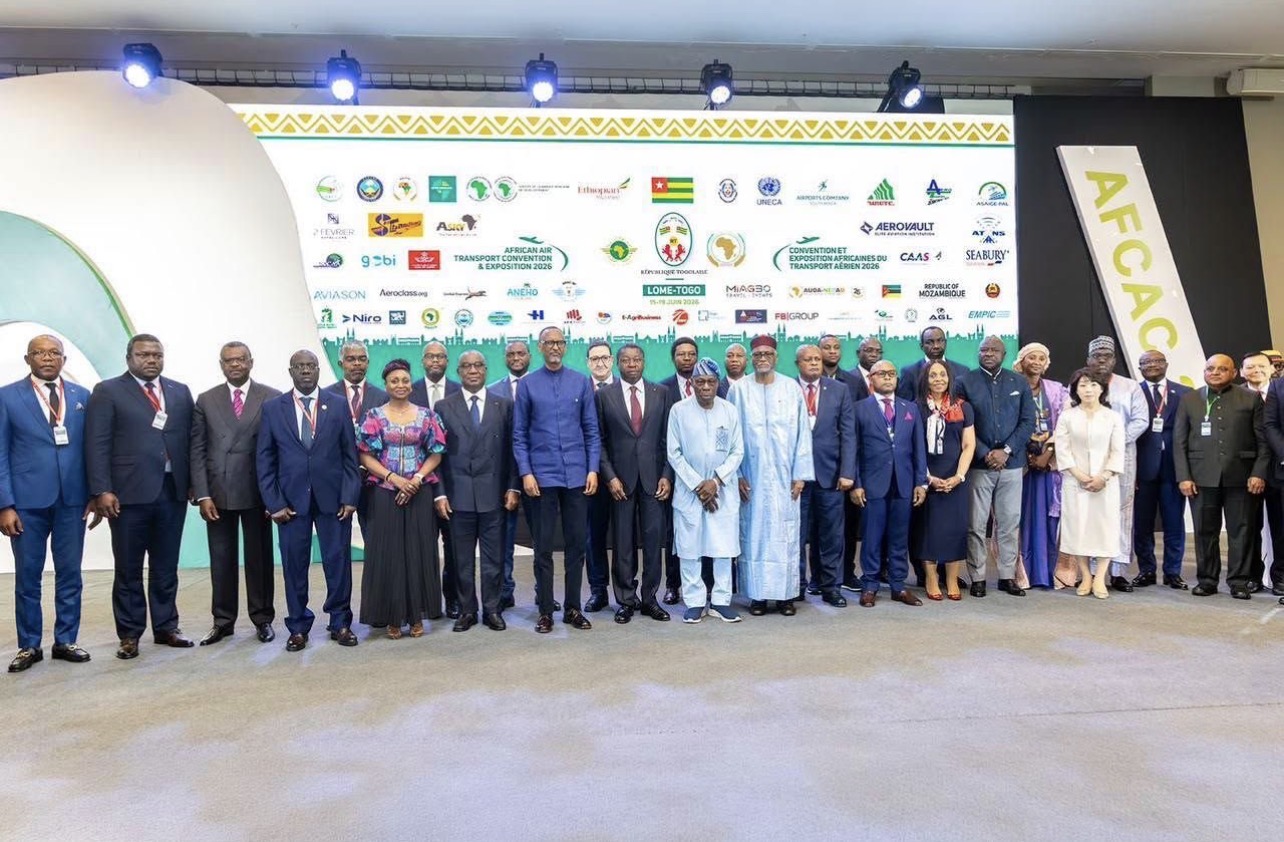
African ministers responsible for transport, tourism, trade and finance have adopted the Lomé Ministerial Declaration and Implementation Matrix aimed at accelerating the development of a more connected, affordable and sustainable air transport market across Africa.
The declaration was adopted during the African Air Transport Convention and Expo 2026 held in Lomé, Togo, bringing renewed political momentum behind the implementation of the Single African Air Transport Market (SAATM) and the long-standing Yamoussoukro Decision on air transport liberalization.
The meeting was organized by the African Civil Aviation Commission (AFCAC) in collaboration with the African Union Commission, the AfCFTA Secretariat and AUDA-NEPAD, under the patronage of Togo’s President, who currently serves as SAATM Champion President.
The declaration represents one of the continent’s strongest recent commitments toward addressing the structural barriers that continue to limit intra-African connectivity, suppress demand and raise the cost of air travel.
Ministers reaffirmed that aviation must be treated as a strategic enabler of trade, tourism, industrialization, regional integration and economic transformation rather than simply a source of government revenue.
A major focus of the declaration was the urgent need to move from political commitments to practical implementation.
African states committed to removing restrictive market access barriers, liberalizing air services, aligning bilateral agreements with SAATM principles and improving administrative processes related to airline approvals and route launches.
The ministers also endorsed a Continental Harmonized Policy Framework on Aviation Taxes, Charges and Fees aimed at tackling one of African aviation’s most persistent challenges: the high cost of doing business.
The declaration acknowledged that excessive taxes, fees and operational bottlenecks continue to weaken route viability, reduce affordability and limit the sector’s contribution to economic growth.
Governments committed to improving coordination between aviation, finance, tourism and trade authorities to rationalize charges while maintaining the sustainability of essential aviation services.
Cargo development also featured prominently in the discussions.
Ministers committed to supporting corridor-based cargo development aligned with AfCFTA trade priorities, including the expansion of intra-African cargo routes, logistics infrastructure and commercial partnerships between airlines, airports and trade stakeholders.
The declaration further emphasized the need to improve seamless travel across the continent through visa openness, digital travel systems, better border management and improved passenger and cargo facilitation processes.
African governments also acknowledged the importance of modern aviation infrastructure, calling for the development and financing of bankable airport, cargo, air navigation and digital infrastructure projects capable of supporting long-term growth.
Sustainability and cleaner aviation energy were identified as growing strategic priorities. Ministers committed to supporting Africa’s participation in the development of Sustainable Aviation Fuels (SAF), lower-carbon aviation energy solutions and enabling policy frameworks to support the sector’s environmental transition.
The declaration additionally places strong emphasis on innovation, technology adoption and human capital development, including support for the next generation of aviation professionals, women and youth participation, and stronger collaboration between training institutions and industry stakeholders.
To strengthen implementation capacity, AFCAC also launched the AFCAC Solidarity Commitment 2026–2028, a resource mobilization initiative designed to support SAATM implementation, technical assistance, capacity building and aviation development projects across the continent.
The declaration comes at a critical moment for African aviation.
While the continent is currently one of the world’s fastest-growing aviation regions, airlines continue to face major structural constraints including high taxes, fragmented markets, weak connectivity, infrastructure gaps and blocked airline funds.
Industry leaders have increasingly warned that without deeper liberalization and coordinated implementation, Africa risks falling behind despite strong growth potential.
The Lomé Declaration is therefore being viewed as an important attempt to inject practical urgency into Africa’s aviation integration agenda after years of slow progress.
If implemented effectively, the measures could help unlock greater connectivity, lower fares, stronger cargo networks and increased competitiveness for African airlines while supporting broader continental trade and tourism ambitions under AfCFTA.



Comments are closed.