
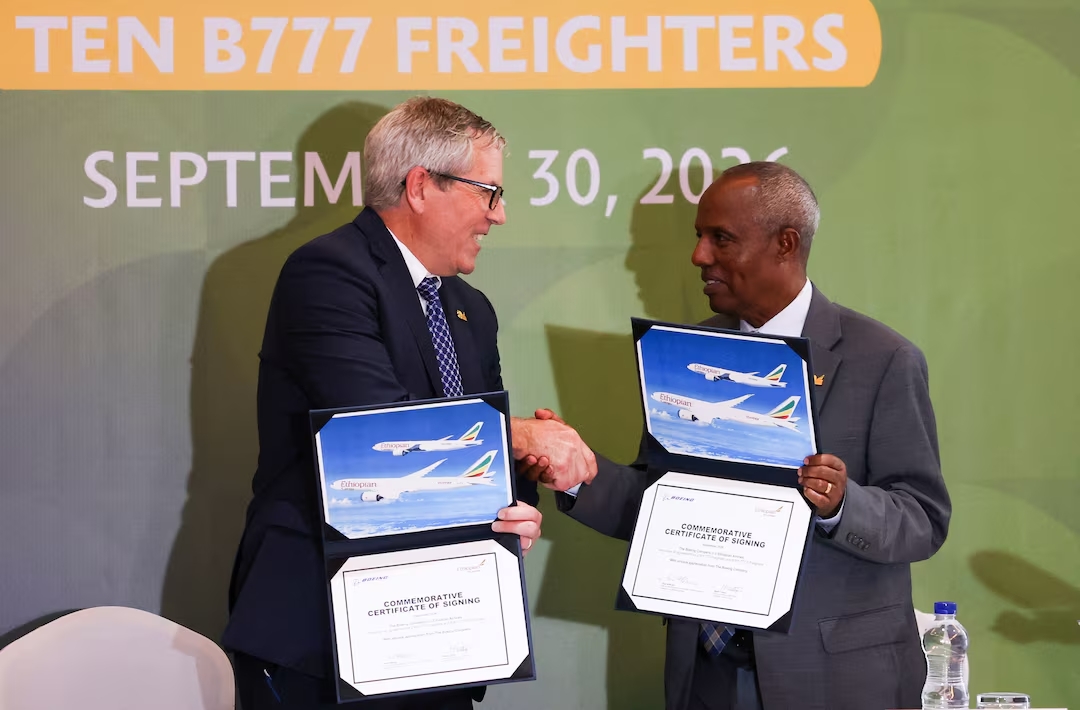
Ethiopian Airlines has placed a firm order for eight Boeing 777-8 Freighters and two current-generation 777 Freighters, significantly expanding its long-term cargo capacity and becoming the first African airline to order Boeing’s next-generation 777X freighter.
The ten-aircraft agreement strengthens an already substantial dedicated freighter operation at Ethiopian and gives the airline additional capacity across two generations of the 777 cargo platform. Ethiopian also holds purchase rights for eight additional 777-8 Freighters, potentially taking its future fleet of the type to 16 aircraft.
The two current-generation 777Fs are scheduled for delivery in 2027 and 2028, while Ethiopian expects the eight 777-8Fs to arrive between 2033 and 2035, according to Ethiopian News Agency, citing Group CEO Mesfin Tasew.
The unusually long delivery horizon for the 777-8F also means Ethiopian will rely on a combination of existing and additional 777Fs to support nearer-term cargo growth before the new generation aircraft joins the fleet.
The agreement builds on a 2022 memorandum of understanding between Ethiopian and Boeing covering five 777-8Fs, but converts the airline’s interest into a significantly larger firm commitment.
Ethiopian strengthens one of Africa’s largest cargo fleets
Ethiopian currently operates 12 Boeing 777 Freighters, two 767 freighters and four converted 737-800SFs, serving more than 70 cargo markets across Africa, Asia, Europe, the Middle East and North America.
Tasew said cargo currently generates about 23% of Ethiopian Airlines’ total revenue, underlining how important freight has become to the group’s wider business model. The carrier intends to continue expanding cargo capacity under its Vision 2040 strategy.
“This agreement marks another significant milestone in strengthening Ethiopian Airlines’ cargo capabilities while supporting the continued expansion of our global network,” Tasew said.
He said the additional aircraft would provide greater payload capacity and operational flexibility while reinforcing Ethiopia’s role as a cargo gateway connecting Africa with international markets.
The airline is also planning to acquire four additional Boeing 777s converted from passenger aircraft into freighters, separate from the ten newly built aircraft included in the latest Boeing agreement.
That would provide Ethiopian with another source of capacity while it waits for its first 777-8Fs.
Moving from the 777F to the 777-8F
The 777-8F is Boeing’s next-generation replacement for the current 777 Freighter and is based on the wider 777X platform.
Boeing lists a maximum structural payload of 118 tonnes for the aircraft and is positioning it as the world’s largest twin-engine freighter. The manufacturer says the aircraft will offer lower fuel consumption and operating costs per tonne than previous-generation large freighters, although those performance claims will ultimately be tested when the aircraft enters commercial service.
For Ethiopian, remaining within the 777 family should also provide operational benefits through fleet commonality.
The airline already has extensive experience operating the 777F, and Boeing says Ethiopian’s existing freighters rank among the most highly utilised commercial aircraft in service. Commonality across the two generations should help reduce some of the complexity associated with introducing an entirely different freighter platform.
The cargo order also deepens Ethiopian’s commitment to the wider 777X programme.
The airline previously ordered eight 777-9 passenger aircraft, making it Africa’s first 777X customer. Adding eight firm 777-8Fs effectively doubles its firm commitment to the 777X family to 16 aircraft.
Tasew said Ethiopian now has 102 firm aircraft orders, of which 84 are Boeing aircraft scheduled for delivery over the coming seven years. He also said close to 80% of the airline’s current jet fleet was manufactured by Boeing.
A significant order in the Airbus-Boeing freighter battle
The timing of Ethiopian’s decision is particularly significant.
It comes immediately after Airbus conducted the maiden flight of the competing A350F on September 29, highlighting an emerging contest between Airbus and Boeing over the next generation of large purpose-built freighters.
The two manufacturers are taking different propositions into that market. Airbus is attempting to establish itself in a segment historically dominated by Boeing with the A350F, while Boeing is seeking to migrate operators of the highly successful 777F onto the larger 777-8F.
With Ethiopian’s commitment, Boeing now has 89 firm orders for the 777-8F, while Airbus has accumulated 115 orders for the A350F, according to FreightWaves.
Ethiopian is particularly important in that competition because it already operates one of the world’s more substantial 777F fleets and has built Addis Ababa into Africa’s largest dedicated air cargo hub.
The airline’s decision effectively keeps its large freighter operation within the Boeing ecosystem for another generation.
Cargo is becoming a strategic pillar for Ethiopian
The order also illustrates how Ethiopian Airlines increasingly sees cargo as more than a supplementary airline business.
Its Addis Ababa operation connects African producers with major consumer and industrial markets across Europe, Asia, the Middle East and North America. The carrier has invested heavily in dedicated cargo aircraft, cold-chain facilities and logistics infrastructure, particularly supporting exports including flowers, pharmaceuticals and perishables.
The airline’s cargo operation demonstrated its strategic importance during the pandemic, when Ethiopian rapidly redeployed capacity towards freight while passenger traffic collapsed.
The latest order suggests that Ethiopian now expects that role to become even larger.
Rather than depending predominantly on belly cargo carried aboard passenger aircraft, the airline is building a dedicated freighter fleet capable of supporting its own network independently of passenger schedules.
That has broader implications for African trade.
Much of the continent’s long-haul cargo capacity is still provided either in the belly holds of foreign passenger airlines or through international freight operators. Ethiopian’s strategy increasingly places an African carrier directly into that global logistics chain.
The 777-8F order therefore represents more than fleet replacement.
With two additional 777Fs arriving first, four converted 777 freighters also planned and eight next-generation 777-8Fs scheduled thereafter, Ethiopian is assembling a bridge between its current cargo operation and the fleet it expects to operate well into the 2030s.
For an airline already using Addis Ababa as a passenger connecting hub for Africa, the strategy points towards an equally ambitious objective on the freight side: making Ethiopia one of the continent’s principal gateways for global cargo flows.

Comments are closed.