
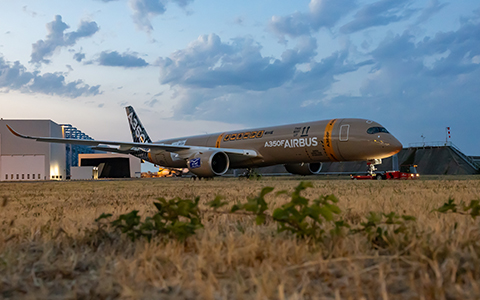
Airbus has successfully completed the maiden flight of its new A350F, formally launching the flight-test phase of a programme that will challenge Boeing in the large widebody freighter market and take Rolls-Royce’s Trent XWB-97 engine into dedicated cargo operations for the first time.
The first A350F took off from Toulouse on Tuesday, September 29, beginning what Airbus expects to be a roughly nine-month certification campaign ahead of planned entry into service in the second half of 2027. The maiden flight lasted around four hours, according to Reuters.
For Rolls-Royce, the milestone opens a new market for an engine that is already well established in passenger operations. The A350F is powered by the Trent XWB-97, the same engine used on the A350-1000, and Rolls-Royce says the powerplant has accumulated more than 4.5 million engine flying hours over eight years in service.
That existing operating history is central to Rolls-Royce’s proposition for the freighter.
Although the A350F represents an all-new cargo variant, its engine does not enter service as an unproven propulsion platform. Rolls-Royce says the operational data accumulated from A350-1000 passenger operations has allowed it to assess the different payloads, utilisation patterns and stage lengths expected from freighter customers.
“For my engineering team, the starting point was to understand the freighter mission properly,” Ian Smith, Rolls-Royce Chief Engineer for the Trent XWB, said in material accompanying the first flight.
“We looked closely at expected payloads, stage lengths, utilisation and operating conditions and compared them with the real-world experience we already have from the A350-1000 fleet.”
Airbus enters a market dominated by Boeing
The significance of the first flight extends well beyond a new A350 derivative.
Airbus is attempting to establish itself in a large purpose-built freighter segment that Boeing has dominated for decades through aircraft including the 747F, 767F and 777F.
The A350F has already accumulated 115 orders from 14 customers, according to figures released around the maiden flight. Reuters reports that this compares with 81 orders for Boeing’s forthcoming 777-8F, making the contest between the two next-generation freighters increasingly important to the future structure of the global cargo fleet.
Airbus says the A350F will carry a maximum payload of 111 tonnes over distances of up to 8,700 kilometres. More than 70% of the aircraft is constructed from advanced materials, while the freighter incorporates a purpose-designed main-deck cargo door and significant structural changes from the passenger A350.
The aircraft nevertheless retains substantial commonality with the wider A350 family, an important consideration for airlines already operating the passenger version.
The programme enters the market at an important moment for air freight. Reuters reports that the global cargo fleet will require around 930 new-build freighters over the next two decades, alongside approximately 2,000 passenger-to-freighter conversions.
A different mission for the Trent XWB-97
Freighter operations create a different utilisation profile from passenger flying.
Cargo aircraft can operate at high payloads, irregular schedules and different stage lengths, while maximising aircraft utilisation is particularly important to express freight and integrated logistics operators.
Rolls-Royce argues, however, that those differences do not necessarily impose a more severe challenge on the Trent XWB-97.
According to the manufacturer, the current A350-1000 fleet typically operates missions averaging around nine hours, with the engine spending as much as 14 hours per day airborne on highly utilised aircraft.
Those passenger flights can combine heavy passenger and baggage loads with large fuel quantities required for ultra-long-haul missions, creating demanding take-off and climb conditions.
The A350F is expected to operate shorter average sectors while carrying higher cargo payloads. Rolls-Royce says its analysis indicates those missions remain comfortably within the operating experience already accumulated by the XWB-97.
That gives Airbus an unusual advantage for a new freighter programme: while the aircraft itself must undergo an extensive certification campaign, its propulsion system enters the cargo market with millions of hours of operational data behind it.
Rolls-Royce targets six-year time on wing
That experience is also feeding into Rolls-Royce’s effort to improve the durability of the XWB-97.
The manufacturer has been implementing a multi-stage durability improvement programme and says an additional upgrade scheduled to enter service from 2028 is intended to increase time on wing substantially.
Earlier this year Rolls-Royce said the first two phases of the programme were already delivering a 60% increase in time on wing, with the third phase expected to double time on wing in challenging operating environments compared with the original configuration and provide a 50% improvement in more benign conditions.
Rolls-Royce says the improvements could allow customers to achieve time-on-wing intervals of up to six years depending on the operating environment.
For freighter operators, durability has particular economic importance. Cargo aircraft frequently generate value through intensive utilisation, meaning an aircraft removed from service for an unscheduled engine event can quickly disrupt network capacity.
Rolls-Royce is therefore positioning its TotalCare maintenance model alongside the engine, transferring agreed maintenance and time-on-wing risks from operators to the manufacturer while using engine-health monitoring to support fleet availability.
A350F begins its certification campaign
The first flight is the beginning rather than the end of the A350F’s development programme.
Airbus has planned approximately 400 hours of flight testing, during which the aircraft will be used to validate aerodynamics, structural loads, systems and thousands of parameters before certification. The manufacturer will also involve operators in testing cargo loading procedures using their own unit load devices and pallets.
Despite being derived from the A350-1000, the A350F has significant structural differences. Airbus describes its fuselage configuration as effectively combining the forward fuselage length of an A350-900 with the rear fuselage length and wings of the larger A350-1000.
Airbus Commercial Aircraft CEO Lars Wagner said following Tuesday’s flight that the company expects the certification programme to last about nine months and remains optimistic about delivering the first aircraft in the second half of 2027.
The programme will ultimately test whether Airbus can break Boeing’s longstanding grip on the factory-built widebody freighter market.
But the propulsion side of that contest has already accumulated years of experience.
For Rolls-Royce, Tuesday’s first flight therefore represents something slightly different from a conventional engine debut: the Trent XWB-97 is entering an entirely new segment without starting again from zero.
With 4.5 million flying hours already accumulated on the A350-1000, the engine that will power Airbus’s challenge for the future of the widebody cargo market arrives there with a substantial operational history already behind it.



Comments are closed.