
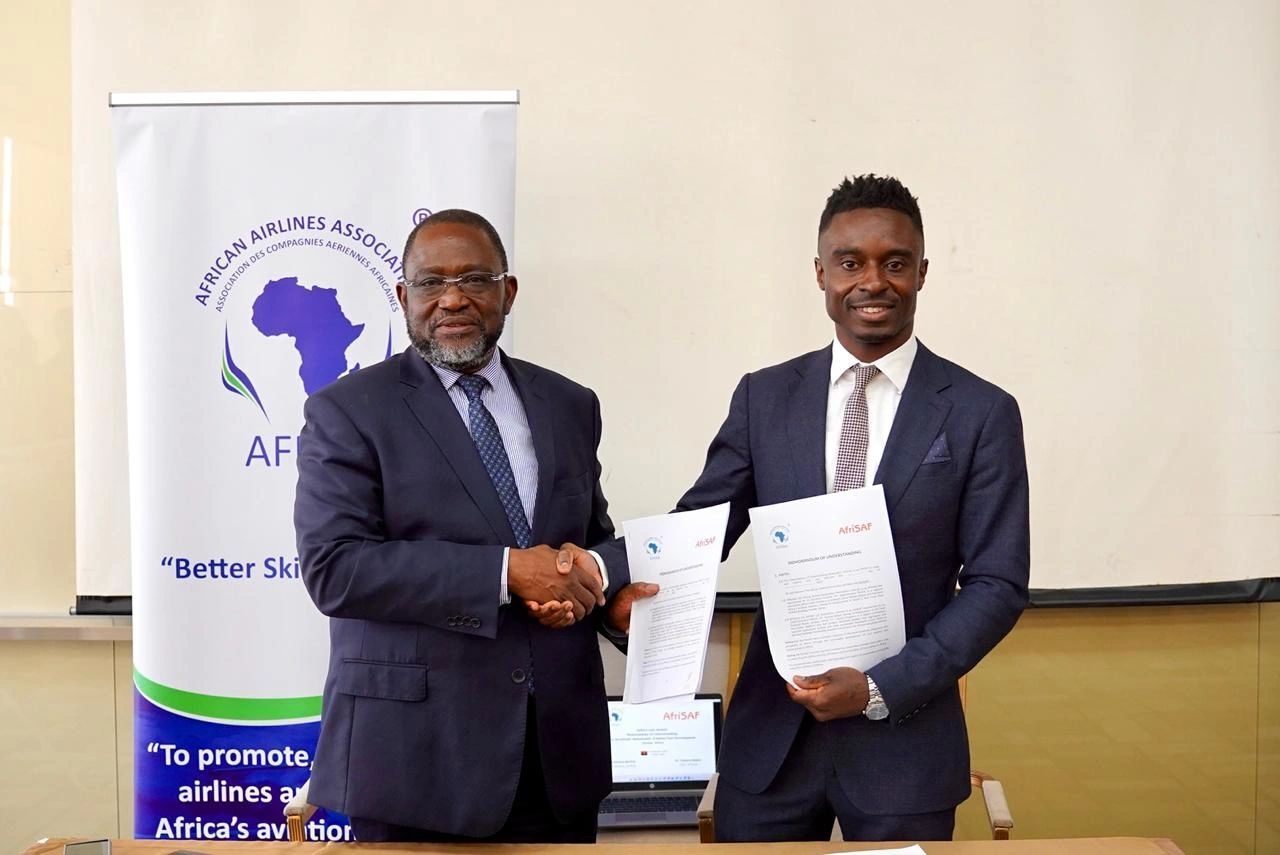
The African Airlines Association (AFRAA) and the African Sustainable Aviation Fuels Alliance (AfriSAF) have taken a decisive step toward decarbonising African aviation with the signing of a comprehensive Memorandum of Understanding (MOU) focused on scaling up Sustainable Aviation Fuels (SAF) production and adoption on the continent.
The agreement was signed by Mr. Abderahmane Berthé, Secretary-General of AFRAA, and Mr. Kwame Bekoe, Chief Executive Officer of AfriSAF, during a ceremony that underscored the urgency and opportunity for Africa to play a leading role in the global transition to low-carbon aviation.
The partnership creates a structured framework for collaboration in five critical areas:
- Advocacy and policy development – leveraging AFRAA’s influence with governments and regulators and AfriSAF’s technical expertise to shape SAF-enabling policies and national decarbonisation roadmaps.
- Capacity building – joint design and delivery of training programmes, workshops, and educational resources covering the entire SAF value chain, from feedstock cultivation to sustainability certification and commercial models.
- Project pipeline development – co-creating a portfolio of bankable SAF production projects, with AfriSAF handling technical feasibility, engineering, and design phases while AFRAA mobilises airline offtake commitments to de-risk investments.
- Resource mobilisation – coordinated outreach to development finance institutions, climate funds, and impact investors to unlock grants and concessional finance for project preparation.
- Sustainable feedstock supply chains – expansion of traceable, deforestation-free feedstock networks using AfriSAF’s digital traceability platform and joint advocacy for international recognition of African SAF pathways under schemes such as CORSIA and the EU’s ReFuelEU Aviation regulation.
Speaking at the signing, AFRAA Secretary-General Abderahmane Berthé declared: “This collaboration with AfriSAF marks a major step in supporting African airlines on their decarbonisation journey. SAF is essential to the future of sustainable aviation, and Africa has immense potential to become a competitive global supplier. Through this partnership, AFRAA will lead the African airlines’ agenda on decarbonisation, ensuring the region’s maximum contribution towards global carbon-neutral growth by 2050.”
AfriSAF CEO Kwame Bekoe added: “Africa has one of the world’s largest untapped volumes of sustainable biomass suitable for SAF production. By combining AfriSAF’s feedstock intelligence, project development capabilities, and digital traceability tools with AFRAA’s industry leadership, we are creating the conditions for Africa to lead in global aviation sustainability. This MOU catalyses a new era of SAF development on the continent.”
The partnership arrives at a pivotal moment. Global aviation has committed to net-zero CO₂ emissions by 2050, and SAF is widely regarded as the most viable near- to medium-term solution for long-haul flights. Yet Africa currently produces virtually no commercial-scale SAF, despite possessing abundant sustainable feedstock resources—ranging from agricultural residues and municipal waste to dedicated energy crops on marginal lands.
Industry analysts estimate that Africa could supply 10–20% of global SAF demand by 2040 if the right policy, investment, and partnership conditions are put in place. The AFRAA–AfriSAF alliance is designed to deliver exactly those conditions.
The two organisations have already begun mapping priority countries and feedstock clusters and are preparing a joint SAF investment prospectus to present to international climate funds and development banks in early 2026.
With African air traffic projected to grow faster than any other region over the next two decades, the continent now has a unique opportunity to build a greener aviation ecosystem from the ground up—rather than retrofitting legacy systems. Today’s MOU signals that Africa’s airlines and SAF developers are determined to seize that opportunity together.


Comments are closed.